
In July 2026, six departments—including the Work Safety Commission Office of the State Council, the Commission for Political and Legal Affairs of the CPC Central Committee, the Supreme People's Court, the Supreme People's Procuratorate, the Ministry of Public Security, and the Ministry of Justice—jointly issued a notice to deploy a nationwide special campaign to crack down on illegal operations and violations in work safety. This campaign is not carried out in isolation; rather, it works in synergy with the Three-Year Action Plan for Tackling Root Causes of Work Safety and the Inspection and Rectification of Major Accident Hazards, forming a comprehensive strategy.
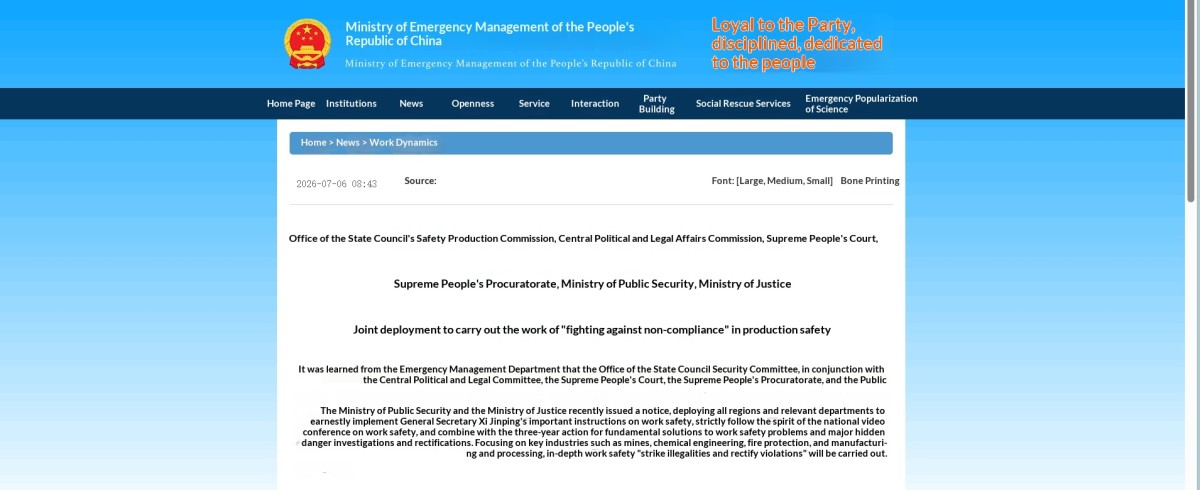
Chemical and hazardous chemical industries are prominently listed among the key sectors targeted for rectification. Within this scope, the refined oil circulation sector has drawn particular attention.
The notice explicitly states that priority should be given to cracking down on prominent illegal acts in the hazardous chemicals sector, such as "unlicensed production and operation of hazardous chemicals, operating beyond the permitted scope, and illegal production by operating enterprises." Applied to the refined oil circulation link, this directly addresses the industry's notorious "Self-owned, Mobile, and Unlicensed" (Ziliuhei) problem—namely, illegal oil storage in self-owned fuel tanks, illegal oil sales via mobile refueling trucks, and unlicensed operations at illegal fueling stations.
Why have these three types of illegal operations become key targets? Four problems make them particularly thorny:
Extremely High Safety Risks
Illegal self-owned fuel tanks are often hidden in factory areas, warehouses, or even residential quarters, lacking professional fire and explosion prevention facilities. Mobile refueling trucks operate around urban-rural fringe areas and construction sites, with operators lacking professional training. Illegal fueling stations are in a state of "three withouts"—no qualifications, no supervision, and no safety guarantees. Once a leak, fire, or explosion occurs, the consequences are unimaginable.
Severe Tax Evasion
Illegal refined oil bypasses tax supervision in formal circulation channels, directly undermining the national fiscal and tax order. According to industry estimates, "Self-owned, Mobile, and Unlicensed" operations cause enormous losses in tax revenue every year.
Unguaranteed Fuel Quality
Non-standard and substandard fuels flow into the market through illegal channels, which not only damages vehicle owners' interests but also aggravates vehicle emissions, undermining the effectiveness of atmospheric environmental protection.
Disrupting Fair Market Competition
Illegal operators capture market share through low prices, subjecting compliant gas stations and transport enterprises to unfair competitive pressure, leading to a clear "bad money drives out good" effect.
It can be said that cracking down on these illegal operations is not an optional choice, but a mandatory requirement to ensure public safety and maintain market order.
Regulatory Pain Points: Why Traditional Seals Cannot Prevent Tampering En Route
Cracking down on illegal fuel activities requires simultaneous efforts at both the source and circulation ends. In the secondary distribution stage of refined oil from depots to gas stations, en-route monitoring during transportation has long been an industry challenge.
For a long time, tank truck transportation relied heavily on traditional lead seals to control oil discharge outlets. A small lead seal, combined with a seal number, seemed sufficient to prove that "the tank outlet was not opened en route." In practice, however, this mechanism has far more loopholes than imagined.
Traditional lead seals suffer from four major regulatory pain points:
Easy to replicate and replace: Identical models are easily obtained; once opened and resealed en route, it is difficult to distinguish with the naked eye.
No opening records: Illegal openings that are restored cannot be detected, making it difficult to assign responsibility when oil shortages occur.
Lack of full visibility: The status of the tank outlet remains unknown during transit, leading to delayed anomaly detection and difficulties in post-event evidence collection.
Low inspection efficiency: Manual checks are time-consuming and labor-intensive, heavily affected by personnel conditions, weather, and time of day, easily leading to management blind spots.
In essence, traditional lead seals rely on "human defense"—depending on people to inspect, check, and manage. However, human attention has limitations, and under the temptation of profit, pure institutional constraints are often easily breached.
This is why the industry has been calling for more reliable technical solutions to upgrade "human defense" into a dual safeguard of "technical defense + human defense."
Solution: Explosion-Proof Smart Seals for Tank Trucks, Building a Closed-Loop Transport Supervision System
To address regulatory challenges in secondary distribution, the electronic smart seal system for tank trucks provides a technical solution. Based on RFID, satellite positioning (BeiDou + GPS), GIS, wireless data communication, and big data analysis technologies, this system integrates positioning tracking, electronic seals, anomaly alarms, and video surveillance into a unified cloud platform, achieving closed-loop management across the entire process—from depot dispatch and en-route transport to unloading at gas stations.
System Architecture: Three-Layer Structure, Edge-Cloud Collaboration
Layer 1: Smart Seal Devices — The "Electronic Locks" of Tank Trucks
Dedicated smart seal locks are installed on the discharge and metering outlets of every tank truck, working in coordination with the onboard central control unit. The lock housings are made of high-temperature, flame-retardant, and explosion-proof materials with high strength, acid/alkali corrosion resistance, and impact resistance, adapting to complex outdoor operating environments. Inside, independently developed pure mechanical lock cylinders fundamentally solve issues such as easy replication, counterfeiting, illegal replacement, and automated identification difficulties of traditional seals.
Layer 2: Onboard Central Control Unit — The Vehicle's "Data Brain"
The central control unit is the core of the onboard system. It retrieves real-time vehicle positioning via dual-mode BeiDou + GPS positioning and exchanges data with backend servers via wireless networks. It monitors state data of every smart seal lock—locking time, unlocking time, and unauthorized openings—storing and synchronizing all data to the cloud in real time.
Meanwhile, the control unit uses location data and smart seal cards to control the locks, ensuring unlocking can only occur at designated locations by authorized personnel.
Layer 3: Cloud Monitoring Platform — The Manager's "Command Center"
The cloud platform supports access via both PC and mobile clients, allowing managers to monitor vehicle status anytime, anywhere. Designed with a cloud architecture and integrated big data analytics, the platform holds 8 software copyrights and provides one-stop services including tracking, anomaly alerts, data analysis, and report generation.
Core Functions: Six Capabilities Safeguarding Transport Security 【Real-Time Vehicle Positioning & Monitoring: Dual-mode BeiDou + GPS positioning makes vehicle locations, routes, speeds, and stop durations clear at a glance. Dispatch centers gain real-time visibility into all vehicles.
Smart Seal Anomaly Alarm: One of the core values of smart seals. If a seal is unlocked at a non-designated location or without authorization, the system immediately triggers an alarm and pushes notifications to managers.
Emergency Sealing & Remote Locking/Unlocking: In emergencies requiring urgent opening, managers can grant remote authorization without sending personnel on-site. Operations remain fully logged and traceable.
Violation Evidence Collection: Every locking and unlocking event generates exact timestamp and location logs, automatically creating electronic evidence for dispute resolution or investigation.
Historical Track Playback: Full historical driving tracks are preserved, allowing managers to replay a vehicle's route on any given day combined with seal opening logs to reconstruct the transport process.
Comprehensive Statistical Analysis: The platform automatically generates statistical reports (trips, unloading logs, anomaly statistics), providing data support for decision-making without manual ledger management.
How Smart Seals Support the Crackdown on Illegal Operations
Returning to the special crackdown campaign deployed by the six departments, smart seal technology supports rectification in the refined oil sector on at least three levels:
1. Cutting off the outflow of illegal fuel at the source
With smart seals installed on all legitimate tank trucks, discharge outlets are under 24/7 electronic monitoring, leaving no room for unauthorized siphoning or fuel swapping. Fuel from formal channels is prevented from leaking into the black market, suppressing illegal operations from the supply side.
2. Providing technical evidence for regulatory enforcement
The notice emphasizes strengthening joint enforcement and improving cross-regional/cross-departmental case transfer mechanisms. Every log and anomaly alarm generated by the smart seal system serves as objective digital evidence, making illegal acts fully verifiable.
3. Driving supervision from "post-event investigation" to "pre-event prevention + in-transit monitoring"
Unlike traditional post-event responsibility tracing, smart seals achieve real-time monitoring throughout transport. Anomaly alerts allow immediate intervention, aligning closely with the official direction to "shift work safety supervision from manual inspection to intelligent control."
Safety Supervision: Technological Defense is Both a Trend and an Essential Need
The joint campaign by six departments sends a clear signal: work safety supervision will become increasingly strict, and the cost of violations will continue to rise. For the refined oil circulation industry, this presents both pressure and an opportunity for standardized upgrading.
The traditional management model reliant on manual labor, static rules, and self-discipline is being replaced by technical, intelligent, and data-driven methods. Implementing explosion-proof smart seals on tank trucks is not merely "changing locks," but upgrading the entire transport supervision system—from "invisible" to "fully transparent," from "post-event accountability" to "real-time warning," and from "human management" to "data-driven control."
When every tank outlet opening is logged and traceable, and illegal operations have nowhere to hide, the soil for "Self-owned, Mobile, and Unlicensed" illegal activities will naturally be cleansed. This is not only a response to policy requirements, but also a commitment to public safety, market fairness, and the long-term development of the industry.
Work safety has no endpoint, and the pace of technology-enabled supervision will never stop.
Awesome! Share to:
Related Posts
- CETC Kingbase Reviews Database Deployment Strengths and Gaps in Oil and Petrochemicals
- Hubei Issues 15th Five-Year Plan for a New Energy System, Targets Peak Oil Consumption
- Iran Says Seven Ships Attacked as Global Oil Prices Surge Above $111
- Russia’s Oil Export Discounts to China Narrow Sharply
- U.S. Crude Oil Futures Rise 2.17% to $100.24 on October 21

First class quality service and professional after-sales team.
In order to provide you the suitable machine , pls offer below message for us
Get in Touch
We respect your confidentiality and all information are protected.