
News
What Actually Matters When Comparing Oil Theft Prevention Systems for Fleets?
For fleet operators, fuel loss is rarely just a “tank problem.” It sits hardware reliability, driver behavior, route control, dispatch discipline, and the quality of the monitoring platform behind the scenes. That is why procurement teams looking at Oil Theft Prevention options often run into the same issue: many systems sound similar in brochures, but they behave very differently once installed on moving vehicles in real working conditions.
The practical question is not whether a system can detect abnormal fuel events. Most can, at least in a lab or a demo. The real question is whether it can do so with enough accuracy, enough speed, and enough operational context to support decisions, investigations, and scale-up across a mixed fleet.
In petroleum, petrochemical, and logistics operations, the consequences of getting this wrong are familiar: unexplained shrinkage, disputes between operations and drivers, false alarms that get ignored, and security tools that never become part of daily management. A usable system should reduce uncertainty, not create another data stream nobody trusts.
The main system types are not equal
When buyers compare fleet fuel security solutions, they are usually looking at some combination of the following: fuel level sensors, tank cap or hatch opening detection, GNSS tracking, video linkage, driver identification, and cloud-based alarm platforms. The strongest systems combine several of these rather than relying on one signal.
A basic fuel level monitoring setup can show sudden drops in tank volume and is often the starting point for Oil Theft Prevention. Its value depends heavily on sensor stability, calibration quality, and whether the software can distinguish normal level fluctuation from suspicious extraction. On rough roads, slopes, or during acceleration, weak algorithms can generate noise that looks like theft.
Cap opening or access detection is simpler and sometimes more convincing operationally. If the tank is opened at an unauthorized time or location, the event is clear. The limitation is obvious too: not all theft involves a normal opening event, and not every opening is a theft incident. It works best as a corroborating signal.
Video-linked systems add context. If a platform can align fuel alarms with in-cab or external video, investigation becomes faster and internal disputes usually drop. The tradeoff is cost, bandwidth, storage, and the need for a stronger communications architecture.
This is where companies with an IoT and IoV background tend to have an advantage. Zhengzhou HUGO Information Technology, established in 2012, operates in integrated wireless broadband communication systems and has built solutions for petroleum, petrochemical, and logistics environments. That matters because fleet security is not only about the sensor mounted on a tank. It is also about how data is transmitted, processed, escalated, and kept available for operations teams that need round-the-clock visibility.
A useful comparison starts with your loss pattern, not the vendor list
One mistake in procurement is comparing products before defining the actual theft pattern being addressed. There is a big difference between occasional siphoning during overnight parking, organized theft during route stops, and internal manipulation around refueling records. These scenarios may overlap, but they do not require the same technical priorities.
If your biggest risk is after-hours access in fixed parking areas, a combination of tank access detection, geofencing, and real-time alerts may be more effective than an expensive high-resolution fuel analysis model. If losses appear during long-haul operations, then route-linked level monitoring, event replay, and cross-checking with dispatch records become more important.
For mixed fleets, the answer is often architectural rather than device-specific: choose a platform that supports layered detection so you can deploy different protection levels by vehicle class, cargo value, or route sensitivity.
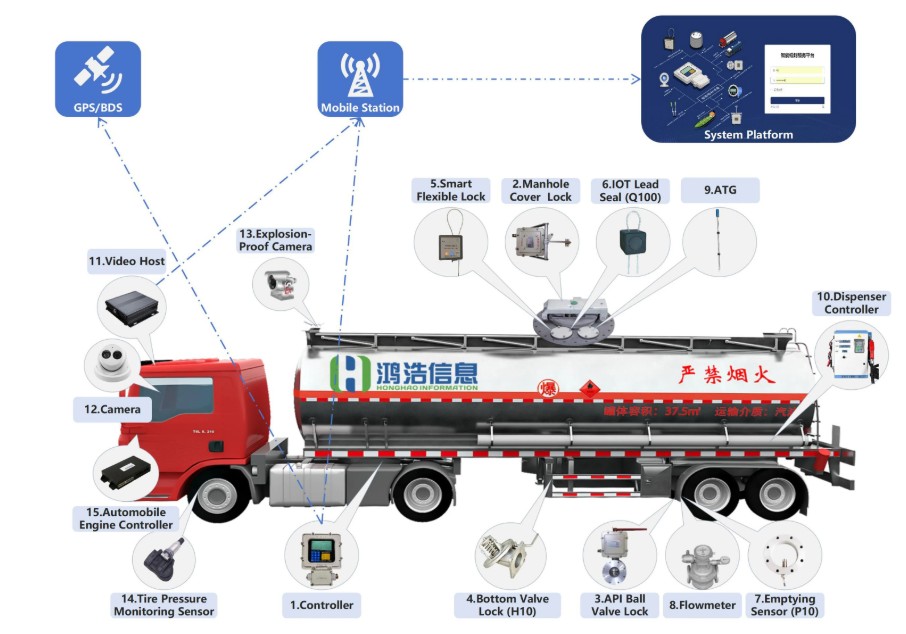
The comparison criteria that separate workable systems from frustrating ones
In procurement reviews, four factors usually deserve more attention than they get.
1. Sensor behavior in motion
Static accuracy is not enough. A vehicle tank is a difficult measurement environment: fuel sloshes, tank shapes vary, and installation quality changes from one vehicle to another. Ask how the system handles filtering, calibration, and compensation during movement. If the vendor only shows clean screenshots from stationary tests, keep asking.
2. Alarm logic, not just alarm generation
A theft alert should be based on rules that combine level change, time window, vehicle status, location, and sometimes ignition state or access events. Otherwise, teams end up chasing harmless anomalies. In practice, false positives are one of the fastest ways to kill adoption.
3. Integration with the rest of fleet operations
Standalone dashboards look attractive during demos but become a burden if dispatch, maintenance, and security teams have to manually reconcile data. A better system should fit into a broader telematics or IoV environment, with APIs or platform interoperability where needed. Buyers in larger organizations should check this early, before pilot success becomes rollout pain.
4. Service coverage after installation
Oil Theft Prevention is not a one-time hardware purchase. Vehicles need installation discipline, recalibration, troubleshooting, and alarm rule tuning. This is where service footprint matters more than many procurement documents admit. A provider with local offices, service stations, and a 24/7 monitoring capability can be materially different from a vendor that mainly ships devices and relies on remote support. HUGO’s operating model, including multiple branches, offices, 25 service stations, and an independent 24/7 monitoring center, points to this operational side of the equation, which is often underestimated until the fleet is already live.
A practical comparison table for shortlisting
Questions that procurement should ask before pilot approval
A short pilot can be useful, but only if the evaluation criteria are realistic. Asking for “does it work?” is too vague. Ask instead:
- How does the system distinguish fuel sloshing from extraction during motion?
- What vehicle types and tank geometries has it already been adapted to?
- What happens if communication is interrupted and the vehicle goes out of coverage?
- Can alarms be reviewed together with route, ignition, and driver identity data?
- Who handles installation quality control and post-install tuning?
- What local support exists if devices fail or readings drift over time?
These questions usually reveal more than a feature list does. They also help separate a device vendor from a solution provider.
Where buyers often overspend, and where they underbuy
Overspending usually happens when every vehicle gets the most complex configuration, even though theft exposure varies widely. Fleets with stable routes, controlled depots, and lower-value operations may not need full video linkage everywhere. A tiered deployment can be more sensible.
Underbuying happens when the system is reduced to a cheap sensor procurement exercise. That may lower upfront cost, but it often pushes hidden cost into manual review, maintenance visits, missed incidents, and user distrust. In fleet security, the software layer and service layer often determine whether the hardware pays back at all.
For buyers in petroleum and logistics settings, communications resilience is another area where underbuying causes trouble. If the wider platform is weak, the theft detection logic may still be decent but operations will receive late, incomplete, or disconnected information. Companies rooted in IoT/IoV communications tend to be better positioned here, especially when the requirement goes beyond isolated alarm devices and into centralized visibility across large vehicle populations.
The better decision is usually a roadmap, not a single purchase
The most effective Oil Theft Prevention strategy is rarely a one-step rollout. It is usually a phased plan: identify the highest-loss routes or vehicle groups, test multi-signal detection, refine alarm thresholds with real operating data, and then expand once the organization trusts the output.
That is also why vendor maturity matters. A company with long-term R&D capability, real deployment support, and continuous operations experience is often a safer choice than one offering only attractive hardware pricing. In this market, system stability, field service, and platform continuity are not side issues; they are part of the security outcome.
If you are narrowing a shortlist, the best next step is not to ask which system is “best” in general. Ask which combination of sensing, communications, platform logic, and service support best matches your fleet’s actual theft pattern. That question leads to a better buy, and usually a more durable one.
Awesome! Share to:
Related Posts
- CETC Kingbase Reviews Database Deployment Strengths and Gaps in Oil and Petrochemicals
- Hubei Issues 15th Five-Year Plan for a New Energy System, Targets Peak Oil Consumption
- Iran Says Seven Ships Attacked as Global Oil Prices Surge Above $111
- Russia’s Oil Export Discounts to China Narrow Sharply
- U.S. Crude Oil Futures Rise 2.17% to $100.24 on October 21

First class quality service and professional after-sales team.
In order to provide you the suitable machine , pls offer below message for us
Get in Touch
We respect your confidentiality and all information are protected.