
News
Cost comparison starts with lifecycle exposure, not the quotation sheet. An oil theft prevention project can look similar across vendors at the proposal stage, yet the total spend changes sharply once installation conditions, communication reliability, alarm quality, maintenance access, and data integration are tested in the field. A low entry price often shifts cost into repeat site visits, false alarms, fuel reconciliation disputes, or delayed incident response during transport and storage.
The first practical comparison point is system architecture. Some offers are centered on a single device, while others combine tank sensors, lock status detection, GPS positioning, communication modules, event logs, and a software layer for alarm handling. Those differences matter because oil theft rarely appears as one clean event. A genuine incident may involve route deviation, an abnormal tank cap opening, a sudden level change during an unscheduled stop, or signal loss just before fuel volume drops. If the architecture cannot correlate these signals, the result is usually a large amount of manual checking after every alert.
Compare detection logic before hardware counts
A proposal that lists many devices is not automatically stronger than one with fewer endpoints. The useful question is how the system distinguishes theft from normal operations such as loading, unloading, thermal expansion, sloshing on rough roads, pump vibration, or parked vehicles on an incline. Tank level sensing should be reviewed together with filtering logic, sampling frequency, and event thresholds. If thresholds are fixed and cannot be tuned for route type, tank geometry, or product characteristics, the alarm stream may become unreliable within weeks.
Ask how the system handles edge cases. For example, a tanker stopping on a slope may create a sudden level shift that resembles extraction. A hatch opening during inspection may trigger the same event type as forced access unless lock state, geofence context, and schedule data are read together. This is where data accuracy becomes a procurement issue rather than a technical detail: inaccurate interpretation consumes labor, weakens trust in the platform, and can cause real incidents to be ignored.
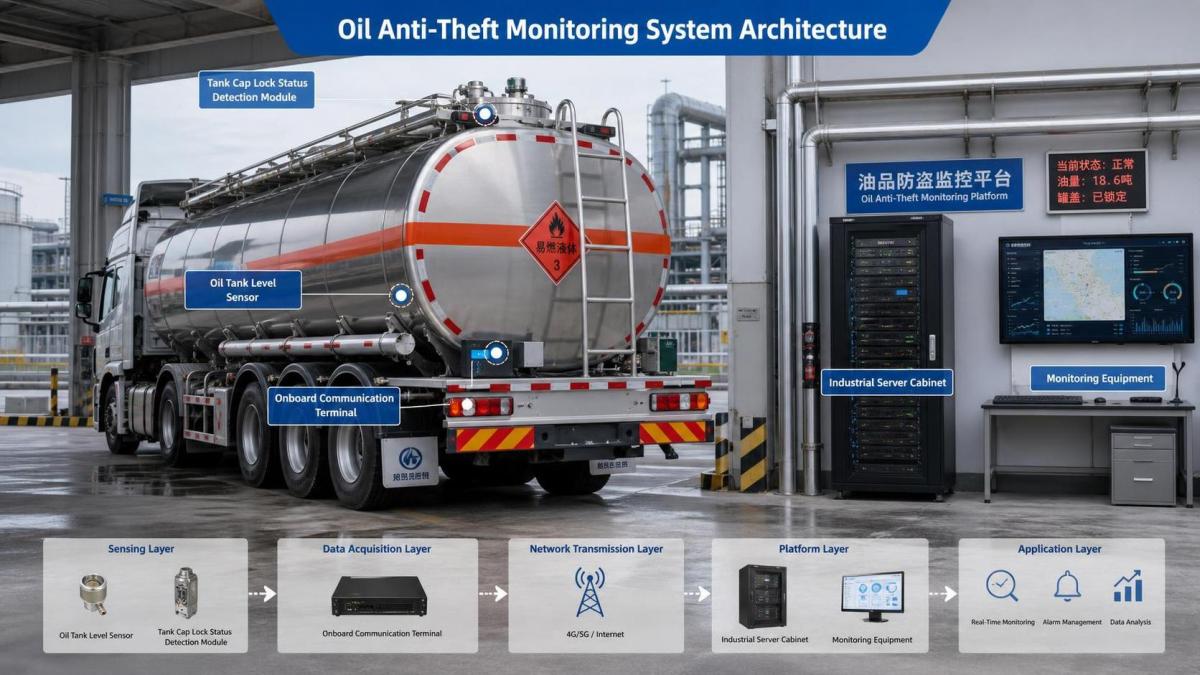
Communication resilience changes operating cost
In petroleum and logistics environments, communication quality is rarely uniform. Urban routes, depots, tunnels, border areas, mountains, and remote unloading points produce different signal conditions. When comparing systems, it is worth examining how data is buffered during outages, how quickly the device reconnects, whether alarms are time-stamped locally, and how duplicate records are prevented after retransmission. A system that only works well under stable network coverage may appear acceptable in a demo and then produce gaps during actual dispatch operations.
Deployment flexibility also matters. Some fleets need retrofit installation on mixed vehicle types, while others need a design that can later expand to fixed tanks, yard access points, or driver behavior linkage. If sensor wiring, power requirements, antenna placement, and enclosure protection are too rigid, the deployment cost rises each time a new vehicle model or tank structure is introduced. Installation drawings should be compared as carefully as the software screens, because poor cable routing, weak sealing, or awkward maintenance access can create recurring faults that look like software problems.
Focus on the tank and sensor interface
The sensor-to-tank interface is one of the least visible but most expensive areas to get wrong. Tank material, wall thickness, internal baffles, manhole layout, and available mounting points all affect signal quality and installation complexity. A solution may perform well on a test rig but require custom brackets, drilling changes, or extra sealing steps on actual transport equipment. Those adaptations increase downtime and can complicate future servicing.
It is also useful to compare calibration method and drift management. Fuel level data is only valuable when it remains interpretable over time. If recalibration requires a specialist on site, a laptop-only tool, or full tank emptying, maintenance cost will grow quietly. If the calibration process can account for tank shape and known volume points without frequent invasive work, operational disruption is lower. This should be discussed before signing because calibration shortcuts often show up later as inventory disputes.
Alarm handling is where many systems fail
Real-time monitoring should be judged by event handling, not by whether a dashboard refreshes quickly. A useful alarm workflow records when an alert was triggered, what correlated signals were present, whether the vehicle was moving or stationary, how the incident was acknowledged, and what audit trail remains afterward. Without that chain, the software becomes a notification board rather than a control tool.
Look at alarm granularity. A single generic “abnormal fuel event” is hard to act on. Distinguishing between cap opening, level drop during unauthorized stop, communication tampering, power interruption, and geofence breach makes incident review much faster. At the same time, a system with too many alarm categories can create confusion if those categories are not tied to actual operating procedures. The right balance depends on whether the deployment involves long-haul transportation, depot storage, or multi-stop delivery.
Integration work can outweigh the device cost
Software and service comparison should include interface depth. Fuel theft prevention data often needs to meet dispatch systems, ERP records, weighbridge data, card-based fueling logs, or existing video monitoring. If exports are limited to screenshots or manual spreadsheets, back-office reconciliation remains slow and error-prone. If APIs or structured data interfaces are available, confirm event fields, historical retention, time synchronization, and user permission scope rather than relying on a general statement that integration is supported.
Another area that deserves attention is account design. Multi-site operations usually need different visibility for dispatch, security, maintenance, and finance functions. If the permission model is too coarse, sensitive data may be overexposed or routine investigation may depend on one administrator. That creates hidden management cost and slows response when incidents happen outside office hours.
Maintenance terms need technical detail
After-sales support should be compared at the component level. It is not enough to ask whether service is available. The better question is what happens when a sensor fails, a terminal goes offline intermittently, firmware needs updating, or a vehicle is reassigned to a different route profile. Spare part availability, remote diagnostics capability, replacement procedure, and fault localization method all influence downtime. A system that can isolate whether the fault is in the power line, communication module, sensor head, or server-side parsing logic is easier to maintain than one that requires blanket replacement.
Service response should also be considered in relation to operating geography. If vehicles cross multiple regions, support that depends on a single local team may create long resolution times. In contrast, a design shaped by IoT and IoV operating experience is more likely to address remote monitoring, distributed deployment, and continuous event supervision as standard engineering concerns rather than optional extras.
Compare evidence quality, not just prevention claims
Some systems are positioned as deterrence tools, others as investigation tools, and some attempt both. The distinction matters because post-incident evidence requirements are stricter than simple alerting. Time-stamped records, location trail continuity, sensor event history, and tamper logs are more useful than a single exception marker. If internal review or external dispute handling may be involved, compare how historical events are stored, searched, and exported. Weak evidence quality can erase the value of real-time alarms.
One final comparison point is operational fit. A technically advanced scheme may still be a poor choice if it requires long installation windows, frequent manual calibration, or constant threshold adjustment across a large fleet. The right decision usually comes from matching theft scenarios, route conditions, tank structure, communication environment, and internal data processes before comparing line-item prices. When those factors are visible early, the final selection tends to reflect controllable ownership cost rather than a narrow purchase figure.
Awesome! Share to:
Related Posts
- CETC Kingbase Reviews Database Deployment Strengths and Gaps in Oil and Petrochemicals
- Hubei Issues 15th Five-Year Plan for a New Energy System, Targets Peak Oil Consumption
- Iran Says Seven Ships Attacked as Global Oil Prices Surge Above $111
- Russia’s Oil Export Discounts to China Narrow Sharply
- U.S. Crude Oil Futures Rise 2.17% to $100.24 on October 21

First class quality service and professional after-sales team.
In order to provide you the suitable machine , pls offer below message for us
Get in Touch
We respect your confidentiality and all information are protected.