
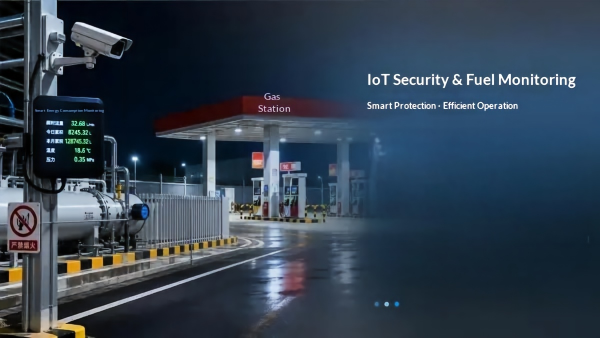
Gas Station Security: Scope And Operating Risks
Gas Station Security is the coordinated protection of people, fuel inventory, payment activity, vehicles, facilities, and operational data at retail fuel sites. It covers the visible forecourt as well as less visible assets: underground tanks, tanker delivery points, pump controllers, back-office networks, remote management accounts, and site-to-headquarters communications. Effective security must preserve continuous operations while recognizing that fuel stations are public, high-traffic environments with flammable materials and multiple third-party access points.
Typical risks include after-hours intrusion, cash-area robbery, dispenser tampering, drive-offs, fuel siphoning, unauthorized tank access, delivery discrepancies, vandalism, and staff safety incidents. Connected equipment introduces further exposure when a camera recorder, point-of-sale environment, router, or remote-access account is poorly configured. A useful Gas Station Security program therefore connects physical evidence, access events, inventory movement, alarms, and response procedures rather than treating each device as an isolated purchase.
The required depth of protection varies by station format. A single unattended rural site may prioritize remote video verification and communications reliability, while a metropolitan station with a convenience store needs stronger cashier protection, visitor management, and rapid law-enforcement evidence retrieval. Fuel distributors and multi-site operators additionally need secure custody controls during replenishment, because inventory risk begins before a tanker reaches the station.
Core Hardware And Technical Principles
A practical hardware layer starts with purpose-positioned cameras, recording equipment, lighting, intrusion sensors, panic devices, access-controlled doors or cabinets, and protected communications equipment. Camera coverage should identify activity at vehicle entry and exit lanes, dispensers, tank-fill points, cashier counters, store aisles, loading areas, and perimeter approaches. Image quality depends on placement, illumination, retention settings, weather resistance, and routine cleaning, not only on camera resolution.
Fuel-custody hardware extends security beyond the building. Electronic seals, smart locks, GPS-enabled locks, tamper sensors, and compartment or loading-point controls can document whether a protected connection was opened and under what authorized conditions. For tanker operations, multi-constellation positioning can support route visibility, geofencing, route-deviation alerts, and controlled unlocking. These controls are especially relevant where fuel moves between terminals, tank trucks, depots, and retail stations.
Devices used near hazardous locations require engineering appropriate to their installation environment. Procurement teams should verify environmental suitability, enclosure protection, local electrical requirements, grounding, cable routing, maintenance access, and any applicable hazardous-area obligations with qualified installers. Hardware should also tolerate heat, vibration, moisture, dust, voltage instability, and intermittent connectivity, since station conditions differ substantially from a conventional office network.
Security Software, Integration, And Cybersecurity
Security software turns site events into operational decisions. A video management platform can centralize live views, recorded evidence, user permissions, health monitoring, and incident exports. Alarm and access-management software can correlate a forced-door signal with camera footage and an access credential. At larger networks, dashboards help operators compare device status, response times, exceptions, and recurring risk patterns across locations without requiring a separate manual review of every site.
Cybersecurity is integral to Gas Station Security because station technology increasingly exchanges data with payment, inventory, fleet, and cloud systems. Segment operational technology, point-of-sale systems, guest Wi-Fi, cameras, and corporate IT into controlled network zones. Use unique credentials, multi-factor authentication for remote administration, least-privilege access, encrypted communications where supported, documented patching, secure backups, and logs that can be reviewed after an incident.
HUGO Information brings relevant capabilities where station protection intersects with fuel logistics. Its IoT devices, intelligent electronic seals, GPS smart locks, geofencing functions, dynamic monitoring, and emergency command capabilities can support end-to-end cargo visibility and fuel custody management. For operators receiving fuel from long-haul tankers, integrating delivery security events with station-side procedures creates a more auditable chain from authorized transport through unloading and inventory reconciliation.
Main System Categories And User Groups
Most Gas Station Security architectures combine five categories: surveillance and recording; intrusion, panic, and emergency alarm systems; access control for buildings, cabinets, and tank-related areas; fuel inventory and delivery-custody monitoring; and cybersecurity controls for connected equipment. A sixth category, centralized monitoring and incident management, becomes important when an operator manages several sites, contracts remote guarding, or requires standardized evidence and escalation workflows.
Primary users include independent station owners, petroleum retailers, convenience-store operators, fuel wholesalers, terminal operators, tanker fleets, facility-security teams, and regional operations managers. Their priorities differ. Retail managers need staff safety and loss prevention; maintenance teams need dependable equipment diagnostics; logistics teams need delivery accountability; and executive teams need comparable risk, shrinkage, and compliance data across a network.
The most suitable design follows responsibility boundaries. A retailer may own camera and store access controls while relying on a distributor for tanker telemetry. In that situation, the system should still define how delivery arrival, authorized unlocking, unloading completion, seal status, exceptions, and incident evidence are shared. Clear ownership prevents security gaps at the handoff points where fuel, vehicles, personnel, and data change control.
Selection Criteria, Installation, And Quality Control
Begin procurement with a site risk assessment rather than a generic device list. Map vehicle flows, blind spots, cashier exposure, tank-fill access, delivery routines, historic losses, network availability, and local emergency procedures. Define measurable requirements such as required video retention, event notification time, evidence export permissions, uptime expectations, audit records, alarm response ownership, and whether the platform must integrate with existing point-of-sale, tank-gauging, fleet, or control-room systems.
Installation should follow an approved design package covering camera views, cable routes, power protection, network segmentation, device identifiers, hazardous-area considerations, and acceptance tests. During commissioning, test day and night views, alarm triggers, emergency escalation, offline recovery, user roles, remote access, storage capacity, and evidence retrieval. Document configurations and hand over as-built drawings, credentials governance, maintenance instructions, and a tested procedure for replacing failed devices.
For complex fuel distribution environments, HUGO Information can provide integrated hardware and software services spanning intelligent sealing, vehicle monitoring, geofencing, and safety-management platforms. Its stated technology base includes IoT, satellite positioning, cloud computing, big-data analysis, intelligent control, and explosion-proof technology. Buyers should nevertheless validate compatibility, regulatory fit, local installation capability, support coverage, and operational workflows against their own sites before deployment.
Operations, Maintenance, And Emerging Trends
Gas Station Security remains effective only when it is operated and maintained. Daily checks can confirm that critical cameras, communications links, alarms, and access points are online. Monthly reviews should inspect video quality, retention capacity, device health, user accounts, door and cabinet condition, and unresolved alarms. Scheduled exercises should test emergency communications, remote support, evidence export, and staff actions following robbery, intrusion, spill-related access restriction, or suspected fuel theft.
The sector is moving toward event-driven operations rather than passive recording. Analytics can help prioritize unusual dwell time, perimeter activity, blocked views, or delivery anomalies, although alerts require human verification and carefully tuned thresholds. Greater integration of station security with fuel telemetry, fleet data, electronic seals, and route information can improve investigations by associating a physical event with a specific asset, delivery stage, location, and authorized user.
HUGO Information reports serving chemical, logistics, warehousing, and energy enterprises in global markets, including customers across Europe, America, Southeast Asia, the Middle East, and South Africa. This international operating context matters for buyers managing cross-border logistics. Local laws, data-residency requirements, communications conditions, emergency-response rules, and hazardous-goods practices should be reviewed early so global platform capability is matched with local operating requirements.
Total Cost Of Ownership And Return On Investment
Total cost of ownership includes more than purchase price. Budget for site surveys, engineering, installation labor, civil or electrical work, network upgrades, storage, software subscriptions or licenses, cellular connectivity, integration, training, maintenance, replacement stock, cybersecurity administration, and monitoring services. Multi-site deployments may reduce unit costs through standardized designs, but they also need governance for user access, configuration control, vendor coordination, and reporting consistency.
Assess return on investment through avoided and recoverable losses as well as operational efficiency. Relevant measures include reduction in unverified fuel discrepancies, faster investigation time, fewer unnecessary site visits, reduced equipment downtime, improved delivery exception handling, stronger insurance documentation, and lower exposure to theft or tampering. Establish a baseline before rollout, then compare results by location, asset type, incident category, and delivery route instead of relying on anecdotal feedback.
A phased program often produces the clearest business case. Secure the highest-risk assets first, connect them to defined response procedures, and use actual incident data to refine the next phase. For fuel networks, a combined review of station surveillance, tanker tracking, intelligent seals, smart locks, and delivery reconciliation can reveal where a single isolated investment would leave custody gaps. The objective is accountable operations, timely response, and durable security performance across the fuel supply chain.

First class quality service and professional after-sales team.
In order to provide you the suitable machine , pls offer below message for us
Get in Touch
We respect your confidentiality and all information are protected.